Journalism in the television age · The Century of Journalism
In the internet age, with all the new “social” media, the formerly new medium of television suddenly seems old with its linearity. But with age also comes a certain standing. Jürgen Habermas (2022), for instance, in his new Structural Transformation of the Public Sphere, places television in the league of the honourable “old media” such as “press, radio, or television” and stresses their productive “role of journalistic mediation and shaping of programmes”, precisely in contrast to the “new media” (Habermas, 2022, p. 44) of the 21st century. These narratives of a threatening potential turning away from society-wide integration through mass media are astonishing. For it was precisely television, which we now miss so painfully as a campfire (see above), that was the target of harsh criticism and the trigger of fundamental cultural pessimism, not least in Habermas’s original Structural Transformation of the Public Sphere (Habermas, 1962).
If television journalism had to be given a face, it could very well be that of Günther Jauch, perhaps the most prominent and popular television face of the Germans. In February 2025, together with Pinar Atalay, he moderated the so-called Quadrell on RTL. And given the choice of whether Friedrich Merz, Olaf Scholz, Alice Weidel or Robert Habeck should lead the new government, probably not a few people would vote for Günter Jauch.
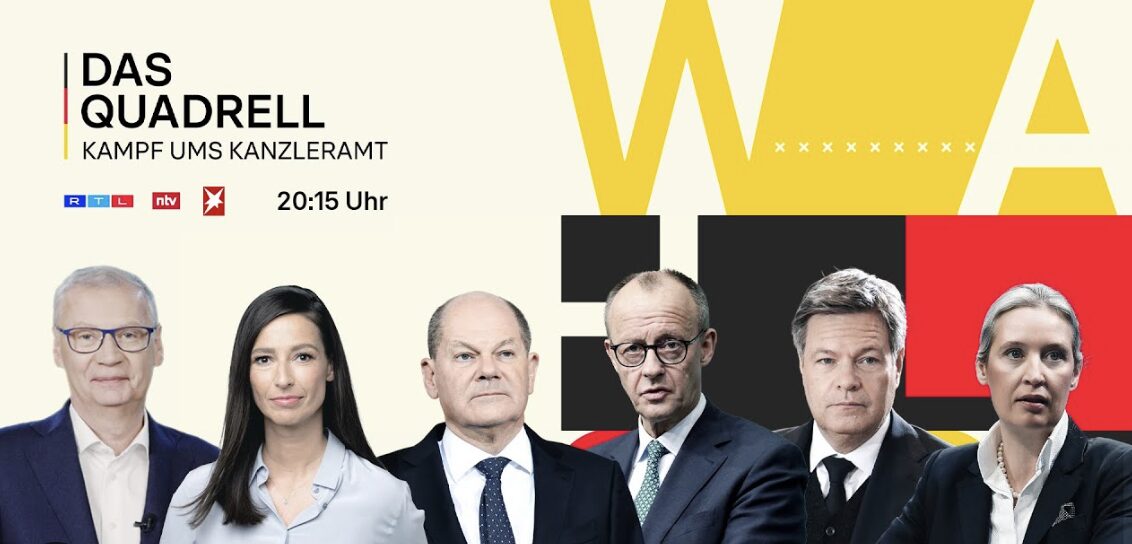
Advertising for The Quadrell 2025 with Günter Jauch and Pinar Atalay
Jauch is a television brand of his own, a personal brand. Jauch does not only host political talk formats, such as the ARD talk show named after him, which was broadcast on linear television from 2011 to 2015, always at 21:45 after the Tatort on Sundays. My colleague Klaus-Dieter Altmeppen called Jauch the “prototype of the new media worker” as early as 2005, who “presents stern-tv as an information journalist”, but also “plays the entertainer as host of ‘Who Wants to Be a Millionaire?’” and thus is also “a prototype for cross-marketing and cross-promotion when he invites contestants from his quiz show onto the programme stern-tv” (Altmeppen, 2005, p. 75). Altmeppen lamented the “gradual disappearance of television journalism” (Altmeppen, 2005, p. 89). And perhaps today there are almost as many TV cooks as TV journalists in front of the camera.
Television is in any case not a genuinely journalistic medium, and in the 2010s some regarded television journalism as the “black sheep of journalism” (Renner, 2007, p. 11), precisely because of its enormous influence. Thus my doctoral supervisor Siegfried Weischenberg justified his swan song for the century of journalism in 2010 by saying that journalism as a whole had submitted to television (Weischenberg, 2010, p. 48). But television was not only the leading medium of journalism and of everyday life, but also of politics, and thus also the leading medium of the mediatisation of politics. This means that politics orientated itself towards the media, and especially towards television, to such an extent that this was described as the subjugation of politics to the media. For the process of an advancing mediatisation of politics, the Swedish communication scholar Jesper Strömbäck presented a phase model in 2008, which culminates in politics being colonised by the media (Meyer, 2001) in a fourth phase. It becomes clear here that subjugation and colonisation are in each case different thrusts of the same phenomenon. An adaptation of the political system to the media can hardly be forced by the media. But acting politicians can well feel compelled to adapt to television.
At this time, however, journalism is dominated above all by print. Of the 48,380 full-time journalists, a good 17,000 worked at newspapers in 2004/05, just under 9,500 at magazines and another just under 3,000 at free advertising papers. Some 1,500 were employed at agencies and media services, 8,000 in radio and “only” a good 7,000 in television. Online media were surveyed separately at the time. There, just under 2,500 journalists worked (Weischenberg et al., 2006b, p. 349).
In this period our figures show above all stability. Most of the newspapers examined have a share of over 50 percent of texts that follow the inverted pyramid principle, the online edition of the Kölner Stadt-Anzeiger at least over 40 percent. The Süddeutsche Zeitung and welt.de lie below that. Here the change in news structure in digital journalism is already hinting at itself.
But let us come back once more to the significance of television and in particular of the political talk shows. At the time people spoke of the talk-showisation of politics. Friedrich Merz (CDU), Chancellor of the Federal Republic of Germany since 2025, said on Sabine Christiansen in 2003: “The programme now determines the political agenda in Germany more than the Bundestag does.” (Merz quoted in Paul, 2020, p. 240, cf. Rossum, 2004). The talk show Sabine Christiansen started in 1998 with its eponymous host and remained the tone-setter in the political scene until 2007, that is, throughout the entire Schröder era and into the early years of Chancellor Angela Merkel. The programme likewise always aired on Sundays after the Tatort and was thus also the predecessor, first of Anne Will (2007-2011 and 2016-2023) and then of Günther Jauch’s programme, which ran from 2011 to 2015.
In 1998, Jauch and Marcel Reif achieved a sports-journalism highlight when, at the Champions League match between Real Madrid and Borussia Dortmund, one of the two goals collapsed before kick-off. The two RTL presenters bridged the subsequent 76-minute wait with sentences such as “The match would benefit from a goal” (Reif) and “For all of you who didn’t tune in in time: you have missed something. The first goal has already fallen” (Jauch).
After all, 1998 was the year in which Pierre Bourdieu’s Über das Fernsehen (On Television) appeared in German (Bourdieu, 1998). We can place it in a series of media-critical, and thus above all television-critical, books such as Thomas Meyer’s Mediokratie (Mediocracy), with the already mentioned “colonisation of politics by the media” (Meyer, 2001), and Richard Meng’s Medienkanzler (Media Chancellor) on the “Schröder system” (Meng, 2002).
Having spoken above about the feminisation of journalism, even if there is still a long way to go, the era of Chancellor Gerhard Schröder and his predecessor Helmut Kohl is a time of dominant male figures, some of whom were distinguished by an unpleasant chauvinism. In 1998 Schröder had abbreviated the Ministry for Family, Senior Citizens, Women and Youth as “Family and Gedöns” (a dismissive word, roughly “fluff”), which he later regretted in an interview with Welt am Sonntag. And he said that to govern he needed “only BILD, BamS and the tube”, which in turn he was sorry about in an interview with BILD. This is the quintessence of a dysfunctional mediatisation of politics. This then led to some so-called alpha journalists (Weichert & Zabel, 2007, 2009; Weischenberg, 2010, p. 48) in journalism too misunderstanding their role and wanting less to observe critically than to actively join in. In the SPIEGEL story ( here you get to SPIEGEL as a century institution) we have likewise devoted a chapter to the Chancellor and the Chancellors. It also covers the fact that Helmut Kohl, Schröder’s predecessor, in fact never gave SPIEGEL a single interview in the 16 years of his chancellorship (1982-1997).
Towards the end of Kohl’s time in office, Herbert Riehl-Heyse (1995) published the book Götterdämmerung (Twilight of the Gods) with the subtitle Die Herren der öffentlichen Meinung (The Lords of Public Opinion), in which he portrays, among others, Reinhard Mohn. Mohn was long-time head of the Bertelsmann group, thus more than a great publisher personality; today we might also say media tycoon. And if we call to mind the discussions about the worldwide media influence of Elon Musk or Mark Zuckerberg with their platforms in the 21st century, Riehl-Heyse wrote a corresponding dystopia about Reinhard Mohn, had he behaved like the media magnate Silvio Berlusconi:
“If Mohn had a vision of an exclusively saving faith, of the only possible way to govern states, and tried to enforce it with the help of all the video films and bestsellers and illustrated-magazine series produced in his name and with his money: the world would have a new chief ideologue with access to means of propaganda that Goebbels and Stalin together did not have at their disposal.”
The worry about overpowering media men was already there in the 1990s. People feared that the pooled media power of television stations and print products would yield an opinion power, which however mostly remained limited to the respective national media markets and media systems. Thus people at the time really did fear that the Berlusconi model could catch on in Europe. Silvio Berlusconi was an Italian construction entrepreneur who bought himself the football club AC Milan and various television stations and further media and eventually became Italian prime minister several times, first in 1994.
Against this background, the World Wide Web, which had been spreading around the globe since the beginning of the 1990s, initially promised true deliberation and a new multiplicity of voices, where an opinion monopoly was widely feared. 1994 is regarded as the starting signal for online journalism, also because SPIEGEL went online then as one of the first news media worldwide ( here you get to SPIEGEL). But it is also at the same time the moment in which journalism lost its monopoly on society’s self-observation and on access to the public opinion market.
None of this was yet to be felt in the first of the studies on journalism in Germany presented regularly here. Journalism was empirically less researched at the time than today; the studies on the American Journalist (see above) had only just reached Germany and now found their first application to Germany in the studies by Weischenberg and his colleagues. For 1993/94 they arrived at about 54,000 full-time journalists, including approx. 18,000 freelancers (Weischenberg et al., 1993, 1994). Compared with today, journalism in Germany in the mid-1990s was perhaps perceived as something like an unknown quantity. Media people were credited with a not inconsiderable share, for instance, in political opinion formation, but this was more presumed than demonstrated.
It is interesting to mention that even then people spoke of a technicisation that would fundamentally change journalism as a profession. Viewed from today, one can regard this on the one hand as particularly far-sighted, but on the other hand also as a recurring trend pattern. For if, as in this project, we look at journalism from a long-term perspective, then alongside change the manifold continuities also become clear.
In our figures, what is striking for 1994 is that, among the major German print leading media, the Frankfurter Allgemeine Zeitung (FAZ) and the Süddeutsche Zeitung (SZ) have under 40 percent of articles following the inverted pyramid principle. This cannot really yet be an effect of the internet, which had just started at the time, but may rather have its causes in the competition from private television. By contrast, the local newspapers are at over 50 percent and Neues Deutschland only just below.
Ten years earlier, in 1984, private television had begun in Germany and has since been, in its excesses, the object of permanent cultural criticism. Thus Riehl-Heyse reproaches Reinhard Mohn, whom he portrays, that his Bertelsmann group is “an important shareholder in that broadcaster which first won its place in the profit zone of the private channels by broadcasting the most banal sex films that German legislators just about tolerate” (Riehl-Heyse, 1995, pp. 157-158). He is aiming at the night programme of the broadcaster RTL, which at a late hour made ratings with little erotic films. The social historian Hans Ulrich Wehler speaks of how privatisation produced a “repellent-attractive underclass programme” (Wehler, 2008, p. 397). The media historian Werner Faulstich, in turn, speaks of the “commercialisation and trivialisation of television” (Faulstich, 2012, p. 376).
The introduction of private broadcasting was of course never a journalistic project. But it was a project driven forward by newspaper and magazine publishers in the justified hope of being able to earn a lot of money with private television and radio. And if later they wanted to blame the internet for the newspaper crisis, it nevertheless turns out that the decline of newspaper circulation in Germany began with the introduction of private television in 1984.
Figure 5.14: The development of the circulation of German daily newspapers. Image source: Faz.net. https://www.faz.net/aktuell/wirtschaft/unternehmen/zeitungen-in-der-krise-medienwandel-und-internet-13089556/die-auflage-deutscher-13089615.html.
Here we can speak of a transformation of German publishers into pure media conglomerates that increasingly see themselves less as financial backers of journalism. This is a slow and by no means irreversible process, which nevertheless now, in the 2020s, increasingly threatens journalism existentially. It begins in 1984. However, it would be unfair to blame the media companies alone for the decline of journalism in the 1980s. These are the years of the great journalism scandals around the Gladbeck hostage drama and around the Hitler diaries and the dead Uwe Barschel in the bathtub, each on the front pages of Stern.
The Gladbeck hostage drama of 1988 ended, terribly, with the deaths of the hostages Silke Bischoff and Emanuele de Giorgi and of the police officer Ingo Hagen. It is regarded as a dramatic police failure and as “probably the clearest example of disregard for journalistic standards” (Weischenberg, 2004, p. 213). The journalists conducted numerous interviews with the hostage-takers and showed the weapons held to the hostages’ heads, obstructed police work and lacked any journalistic distance (here you will find further information from NDR).
The year before, in the northernmost federal state, Schleswig-Holstein, the CDU Minister-President Uwe Barschel had come under suspicion of fighting his challenger Björn Engholm with “dirty tricks”. This is what SPIEGEL (here you get to the century institution SPIEGEL) had reported in its cover story, and it was sharply criticised for it by the competition, among others by ZEIT. The media were thus already involved in this political scandal (here you will find further information from NDR). But because the Stern reporter Sebastian Knauer broke into Barschel’s hotel room in Geneva and photographed the politician lying dead in his bathtub, it became a media scandal and eventually a milestone in German journalism history.
As already mentioned above with regard to BILD, a transgression of boundaries does not necessarily shift the boundary; it can also mark it and thereby make it visible. In ZEIT, for instance, Marion Dönhoff accused Knauer. One can rightly judge Knauer's conduct, as a person and as a journalist, to have been wrong. In terms of media ethics, however, it is not only the individual reporter who is responsible, but equally the editor-in-chief, the media company Stern, the publishing house behind it, and thus ultimately the media system as such. Yet media and journalism are reluctant to raise the question of the system, as we were able to observe in the Relotius case. Incidentally, the audience too could be held responsible for the demand for such scandals and sensation-hungry images. Here, following Pürer (2015, 88-101, see also Pürer, 1992; Weischenberg, 2004; Brosda, 2010), we can therefore distinguish roughly between
- Individual ethics
- Professional ethics
- Institutional ethics
- Audience ethics
differentiate (on media ethics see in more depth the book by Schicha and Brosda (2010). A special case some years earlier was the scandal around the forged Hitler diaries. Shortly after Stern announced the sensation in 1983 that it had the diaries of Adolf Hitler, it already had to admit that it had been taken in by the forger Konrad Kujau (further information can be found at NDR). All instances failed at the time, starting with the reporter Gerd Heidemann and the head of the contemporary history desk Thomas Walde, who deliberately did not inform the editor-in-chief at first, through to publishing director Gerd Schulte Hillen (Gruner + Jahr) and the already mentioned Bertelsmann head Reinhard Mohn. Stern publisher Henri Nannen apologised to the readers. The affair has not only been extensively worked through but also entertainingly rendered in the film Schtonk! by Helmut Dietl.
1984 was the next measuring point in our data collection. It shows that the West German newspapers examined mostly have a share of articles following the inverted pyramid principle (Pyramidenprinzip) at or just below 50 percent. The East German newspaper Neues Deutschland is just over 40 percent, the other newspapers around 50 percent and in some cases clearly above.
The years before 1984, when private television was introduced, were years of journalistic stability and growth, but also of concentration processes in the press, in the course of which the number of providers fell. This means that the share of so-called single-newspaper districts rose at that time from 15% to 45%, and it then increased drastically once more between 1992 and 2026, as we can see from the Wüstenradar (desert radar) of the Netzwerk Recherche.
This means that in Germany there are more and more districts in which there is only one newspaper, and thus no local journalistic competition. Yet local journalism is important for democracy, on the spot and as a whole. This is evident in the USA, where there are by now communities with no daily newspaper at all. While we do not yet have such newspaper deserts in Germany, the worry about a steppe-like desertification of the local journalistic landscape in Germany is not unfounded. This process, however, began as early as the first decades of the Federal Republic.
In the meantime television boomed, and private television in particular was, as shown above, criticised in many ways for its effect on society and especially on politics. For the economisation of the media system that came with privatisation was thought through further as the “colonisation of politics by the media system” (Meyer 2001: 10) and thus as the fourth phase of mediatisation (Strömbäck 2008: 240). In the model of my Swedish colleague Strömbäck (2008) already mentioned, the fourth phase had been preceded by a third (Strömbäck, 2008, p. 238) in which the dominance in the relationship between politics and the media tips over, and the 1980s can be regarded as the beginning of this tipping. In this phase and the preceding second phase we can speak overall of a balance of power (Birkner, 2018), in which the media and politics met on an equal footing. And this was indeed due to a growing importance of journalism in society.
Looking at the circulation sold, we see the peak of print journalism at the beginning of the 1980s. The Social-Liberal era, with Helmut Schmidt and before him Willy Brandt, had brought politicians into the Chancellery who had at times worked as journalists, who understood how the media of their time functioned and who accepted the role of journalists in society. Here you can go to portraits of the German chancellors, from Merz back to Adenauer, in SPIEGEL.
In our figures for 1974, what stands out above all is the East German newspaper Neues Deutschland, with under 30 percent of articles following the inverted pyramid principle (in percent). If one looked at the figures purely chronologically from 1954 to 1974, one could diagnose a decline of this form of news writing in GDR journalism. But the figures rise again in 1984, and the mean for Neues Deutschland for the years 1954 to 2024 is 40.92 percent, almost identical to that of the Süddeutsche Zeitung over the same period: 40.52 percent.
In GDR journalism too, news is “in the ranking of journalistic genres […] in first place”, but above all as a “particularly sharp and indispensable weapon in the ideological class struggle”, as Daniela Grobe quotes in 1994 in her dissertation from the relevant specialist literature of the Karl Marx University in Leipzig (Grohe, 1994, p. 8; cf. Blumenauer, 1988, p. 94; Röhr, 1983, p. 9). For unlike in the West, where impartiality is held to be a requirement of news (Grohe, 1994, p. 33; cf. Weischenberg, 1988, p. 16), the “principle of partisanship” in the socialist journalism of the GDR is “the central principle” (Grohe, 1994, p. 45; emphasis in the original). In the GDR, journalism “always belonged to the political field, unlike in Western societies” (Meyen & Fiedler, 2011, p. 11), which is why we want to look at it in particular here, but not in isolation, rather embedded in the history of journalism across the whole of Germany.
Journalism in the GDR
Neues Deutschland was the great newspaper of the GDR and one of the few that survived the takeover of the East German media by West German publishers. Another newspaper with an East German biography is the Berliner Zeitung, which celebrated its 80th birthday in 2025 and which, through its contentious publisher Holger Friedrich, is itself repeatedly the subject of journalistic reporting. In the decades since German reunification the newspaper has had a very eventful history. In their book Ein Ost-West-Labor – die Redaktion der Berliner Zeitung zwischen 1989 und 2020 (An East-West Laboratory: The Editorial Office of the Berliner Zeitung between 1989 and 2020), my colleagues Maria Löblich and Elisa Pollack (2025) distinguish a total of seven phases, which we list here backwards, following our own logic. In doing so we also give an admittedly unsystematic overview of the media system of the whole of Germany over the past almost forty years. A more recent trend towards own brands and own publishing houses, and again towards publisher personalities, can be seen here. Previously, larger publishing groups were dominant, in part also foreign investors. At one time the Berliner Zeitung belonged to the Cologne publisher DuMont, then to the British Mecom group and before that to Gruner + Jahr. The changeable ownership of the Berliner Zeitung reflects the dynamics of the German media system well, and in Löblich and Pollack it is additionally linked with different phases of the discourse about the GDR past in the editorial office:
Phase 7: With the takeover of the publishing house by the East German owners Holger and Silke Friedrich, the turn away from the dictatorship discourse became, from 2019, “part of the economic and journalistic programme” (Löblich and Pollack, 2025, p. 398). This showed above all in the fact that Holger Friedrich in the Berliner Zeitung “denounced the collective stigmatisation of East Germany in the public service media” (Löblich & Pollack, 2025, p. 340).
Phase 6: Before that, a “new attention to the East” had already arisen and “the topic of the GDR had been identified as a market opportunity”. However, under the Cologne DuMont Verlag there had also been, since 2009, “massive cost-cutting measures, waves of redundancies and a smashing of the editorial office and its identity” (Löblich & Pollack, 2025, p. 398).
Phase 5: Job cuts had also been feared under the British Mecom group from 2005 to 2009. But the editorial office “was, contrary to expectations, hardly thinned out”, although the brief was probably above all returns.
Phase 4: The phase under the ownership of the West German publisher Gruner + Jahr actually breaks down into three phases, the third phase, including a Holtzbrinck interim from 2002, being marked by a course of austerity, while at the same time the “readership market of the so-called new Berlin Mitte” was to be conquered: “East-West differences were considered settled, and the topic of the GDR, as the signals from the editors-in-chief in the early 2000s had it, required no further attention.”
Phase 3: “From the mid-1990s Gruner + Jahr provided a lot of money to build up a prestige paper modelled on West German leading media. With an Austrian/West German leadership duo and two new political editors, the dictatorship discourse mentioned is institutionalised in the editorial office, because for the Austrian editor-in-chief Michael Meier in particular the GDR was above all one thing, a dictatorship, and he wanted to give the victims a voice with the Berliner Zeitung (Löblich & Pollack, 2025, p. 331).
Phase 2: After the purchase by Gruner + Jahr, under a joint East-West leadership “the maxim at first was: keep East readers, win West Berlin. West editors were hired. On the treatment of the GDR there were ambivalent signals.” On the one hand Stasi revelations were supported, on the other “doubts about the societal practice of coming to terms with the past were also published.” (Löblich & Pollack, 2025, p. 397).
Phase 1: After the Wende and the break with the SED-PDS, “the aim was to position the Berliner Zeitung as a non-party newspaper in a private-sector market. Broad sections of readers were still to be addressed. The editorial office aligns itself with the reform discourse of the autumn of the Wende. The first West Germans join” (Löblich & Pollack, 2025, p. 397).
It is remarkable here that Weischenberg et al., in the first study on journalism in Germany cited above, already in 1993/94, so quite soon after the Wende, found that the GDR journalists who had remained in journalism were, in matters of attitude, quite soon rather similar to those socialised in the West. The figures on journalism in the GDR likewise rest on estimates, according to which just under 11,000 journalists worked in the GDR (Weischenberg et al., 1993, p. However, many then lost their jobs with the Wende.
The end of the GDR was also a profound change for journalism. Two very different media systems became one. In many cases this resembled a hostile takeover of the East by the West. Karsten Rudolph writes on this: “The brutal winding-up of East German broadcasting was bound to raise problems of acceptance that could not simply be swept away.” (Rudolph, 2025, p. 158) For the print sector, at that time still extremely strong, Mandy Tröger (2019) in particular has worked out how financially strong West German publishers bought up the East German newspaper market. Sylvia Dietl, in her work on the Transformation und Neustrukturierung des DDR-Rundfunks im Prozess der Wiedervereinigung Deutschlands (Transformation and Restructuring of GDR Broadcasting in the Process of the Reunification of Germany), comes to the conclusion: “The unique chance to constitute an all-German broadcasting order which, in its public service part, is fully oriented towards the guiding values of public service broadcasting, makes them really possible and secures them, was not used.” (Dietl, 2022, p. 614) In this, “West German television in the collapse of the GDR” played a central role, as my colleagues Frank Bösch and Christoph Classen put it:
“It informed the first East German protesters about similar actions and promoted the influx. At the same time the West German cameras were a certain shield against a ‘Chinese solution’, that is, the use of weapons. Above all on 9 November, the West German news about freedom to travel intensified the East German rush at the border crossings, which led to an earlier opening of the Wall. In the course of the fall of the Wall, a change also began in the media of the GDR. To win back credibility, they now reported more openly on the protests and grievances in their own country. GDR television broadcast the four-hour demonstration on Alexanderplatz live on 4 November 1989, and the viewing figures of the ‘Aktuelle Kamera’ suddenly rose steeply.”
The Aktuelle Kamera was the East German counterpart to the Tagesschau, the main news programme on GDR television. And East German television too, in the years before the Wende, had probably contributed to the displeasure of GDR citizens, and thus to the end of SED rule, through the gaping divide between “reality and media fictions” in its reporting (Meyen & Fiedler, 2010, p. 59). It should be noted that, because of the restrictions on public discourse, East Germans quite generally distrusted media messages, “including the offerings from the Federal Republic” (Meyen & Fiedler, 2010, p. 58).
West German television had nevertheless had a strong influence in the GDR, and after the Wende too people in the GDR liked watching television very much. “In the East not only was more television watched than in the West, more radio was also listened to.” (Dussel, 2010, p. 279)
On the perception of the media in the freshly “turned GDR”, the former SPIEGEL editor-in-chief and inventor of SPIEGEL-TV, Stefan Aust, tells an anecdote (here you can go to SPIEGEL as a century institution). There, SPIEGEL-TV was so well known that a SPIEGEL editor once had to explain that he was from the print magazine Der SPIEGEL and not from SPIEGEL-TV. The reaction was: “Oh, are they doing a newspaper now too?” (Aust, 2021, p. 340).
In the GDR the West German press was banned and West Germans did not read newspapers from the East (Bösch & Classen, 2015, p. 450), while East Germans used so much West German radio and especially television that Hesse (1988, p. 9) spoke of a nightly “electronic reunification” even before the Wende. For the terrestrial signals of West German television could be received in almost the whole of the GDR, except in Dresden. That is why the abbreviation ARD in the GDR stood not only for the Arbeitsgemeinschaft der öffentlich-rechtlichen Rundfunkanstalten der Bundesrepublik Deutschland (the consortium of the public-service broadcasters of the Federal Republic of Germany), but also for Außer Raum Dresden (outside the Dresden area).
There and in the whole of the GDR there were of course, besides television and radio, also newspapers and magazines. Bösch and Classen (2015, pp. 459-460) point out that the magazine market in the GDR was less differentiated and more ideologically charged than in the West, but that in both parts of Germany it helped to divide “societies by generation and gender, by hobbies, interests or lifestyles” and thereby shaped “preferences, norms or certain patterns of behaviour”. The West German Bravo, for instance, had its counterpart in the East in the FDJ monthly magazine neues leben, where Professor Bormann answered those questions about love and sexuality that Dr Sommer took care of in the West (Bösch & Classen, 2015, pp. 460-461).
So the media likewise fulfilled their function in the GDR, but with journalism the matter looked somewhat different, for most GDR journalists saw themselves “not as neutral reporters, but as politicians, as advocates of socialism and the GDR, and as teachers” (Meyen & Fiedler, 2010, p. 362). This corresponds more to the role self-understanding of the collaborator in the model by Thomas Hanitzsch and Tim Vos presented further above. The framework conditions of the profession were simply special.
Journalists in the GDR mainly did PR for the GDR, also because journalistic self-control by colleagues and competition was lacking. On the occupational image of the journalist, Otto Altendorfer (2004, p. 249) cites the Wörterbuch des sozialistischen Journalismus (Dictionary of Socialist Journalism): “The socialist journalist is a functionary of the party of the working class [...] or of a social organisation and of the socialist state power, who takes part with journalistic means in the direction of ideological processes.”
Journalist training in the GDR took place at the Section of Journalism (Sektion Journalistik) of the Karl Marx University in Leipzig, at the so-called “Red Cloister”. There, however, the emphasis was above all on ideological training in the spirit of socialism and communism, and so the role assigned to the press by Lenin was in the foreground. Annoyed by this, among others, was Hermann Budzislawski, who from his US exile during the Second World War went not to the West but to the East. There he was placed at Leipzig journalism, where he tried “to scale back the teaching of Marxist foundations in favour of genuinely journalistic course content.” (Siemens, 2022, p. 204). This approach, according to the historian Daniel Siemens, however quickly brought him trouble with the authorities. In his Budzislawski biography he writes that it was not Budzislawski who had made it in the GDR – the GDR had done for him (Siemens, 2022, p. 233).
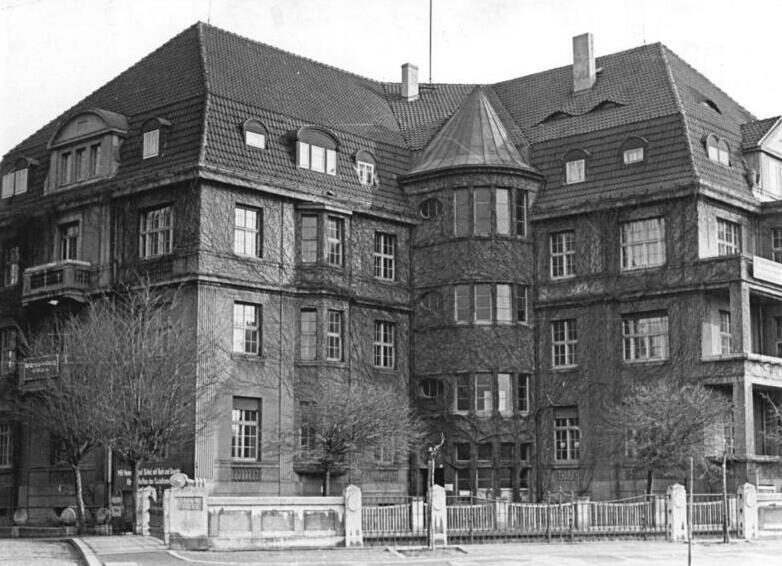
The so-called “Red Cloister”, the Section of Journalism at the Karl Marx University in Leipzig https://de.wikipedia.org/wiki/Sektion_Journalistik_an_der_Karl-Marx-Universität_Leipzig#/media/Datei:Bundesarchiv_Bild_183-18814-0004,_Leipzig,_Universität,_Institut_für_Publizistik_und_Zeitungswissenschaft.jpg
It was, after all, the politicians who made the rules and also decided “what good journalism” was (Meyen & Fiedler, 2011, p. 363). A special role fell here to Erich Honecker: “In the almost two decades of his rule, the party leader arranged the media apparatus in such a way that in the end it embodied his person in an unprecedented manner. Every even half-way important decision went across his desk,” writes my colleague Anke Fiedler (2014, p. 298). Every day he wanted to have the pages of ‘Neues Deutschland’ for the next day submitted to him, even on trips abroad (Meyen and Fielder, 2011, p. 11), and he himself often intervened in the news coverage. He believed he could thereby influence the opinions of citizens. This seemed justified at least in that newspaper circulation in the GDR was particularly high by world comparison (Fiedler, 2011, pp. 11-12).
Yet we know from research that we must not underestimate the readers of Neues Deutschland any more than those of BILD, for they did not “believe everything in print, but appropriated information in a wilful, selective way and sometimes with cynical mockery of the ‘powerful’.” (Bösch & Classen, 2015, p. 458).
The media consumption of GDR citizens was also the subject of a remarkable reporting trip by ZEIT. Our protagonist Marion Dönhoff (here you can go to Marion Dönhoff as a journalist of the century) also took part in this large journalistic report on the GDR. Together with her ZEIT colleagues Rudolf Walter Leonhardt and Theo Sommer, in 1964 she had presented, with the book Reise in ein fernes Land (Journey to a Distant Land), a report on culture, economy and politics in the GDR (Dönhoff et al., 1964). The GDR was at that time distant to many West Germans, while East Germans, as mentioned, liked to watch television westwards, although of course they were not allowed to: “Everyone watches it; not even the party members take the pledge forms promising not to do so seriously. One evening I was in five flats, and in all five the West German programme was switched on.” (Sommer, 1964, p. 103)
In our data on the inverted pyramid principle we see on 30 June 1964 that above all the local Grafschafter Nachrichten stands out upwards.