Journalism and Migration · The Century of Journalism
The sharp criticism of politics and the media during the coronavirus crisis can only be explained in the light of the social conflicts of the preceding “refugee crisis”, which reached its peak in 2015. Perhaps the public discourse about the pandemic would have run differently if, as a society, we had not already quarrelled so intensely over the migration movements of the 21st century, triggered by violence, climate change, hunger and terror (Luft, 2016). The gain of telling the story backwards lies in the fact that we can allow this thought and let it take effect.
In his book Die Metamorphose der Welt (The Metamorphosis of the World), published in German in 2017 and in English in 2016 and left unfinished in 2014, the sociologist Ulrich Beck, who died on 1 January 2015, wrote right at the beginning (2017, p. 11): “The world is out of joint.” Both the external order and the inner cohesion were gone, he said. And at the end he predicted how the “First World” would try “to defend the remnants of its abundance with laws and border fences”, while “many young people from the poorest regions of our planet” would set out “to storm the borders with all their might, driven by the hope of a better life” (Beck 2017, p. 252). And he spoke of the mass media that would “carry events of global significance into every living room on the planet” (Beck, 2017, p. 12). Since then the topic of migration has played a significant role, especially in election campaigns, even though the number of immigrants in Germany has fallen markedly. On 1 June 2026 BILD wrote that the number of immigrants had halved. That was an asylum bang. Two weeks earlier BILD had still warned of a new wave of asylum seekers.
In fact, my colleagues Marcus Maurer, Pablo Jost, Simon Kruschinski and Jörg Haßler, in their study Fünf Jahre Medienberichterstattung über Flucht und Migration (Five Years of Media Coverage of Flight and Migration), are able to show that the portrayal of refugees in the media they examined between 2016 and 2020 was “predominantly negative and thus, in particular, markedly more negative than during the so-called ‘refugee crisis’ of 2015/16”. The attempt at balance produced disturbing blossoms at the time. While refugees kept drowning in the Mediterranean, ZEIT seriously debated whether one should not simply let sea rescue be. Since 2016, however, this negative coverage of refugees has been in line with the decades-long coverage of “criminal foreigners” in German media (Delgado, 1972; Handel, 1997; Hömberg & Schlemmer, 1995; Ruhrmann, 1998), as my colleagues Florian Arendt, Hans-Bernd Brosius and Patricia Hauck (2017) argue. Quite generally, research shows that migrants are mostly reported on negatively (news factors) and frequently in connection with crime.
In particular, the association of refugees with terms such as “stream of refugees” was frequently invoked and just as frequently criticised. But not only from newspapers and magazines, from television too “waves of refugees” washed into our living rooms and triggered waves of outrage on social networks, which in turn flooded and overwhelmed politics by way of the media. The historian Heinrich August Winkler (2019, p. 828) describes this overstretch of 2015, in retrospect, as follows:
“The national-conservative and right-populist AfD received a powerful boost from the influx of migrants. Many municipal and state authorities were overwhelmed by the enormous number of newcomers from other countries; the same applied to the police, the courts and the schools. The integration of hundreds of thousands of people from foreign cultures, mostly shaped by authoritarian and patriarchal attitudes and by hostility to Israel and Jews, proved much more difficult than expected, as did their integration into the labour market. Sexual assaults and violent acts by young, mostly Muslim migrants brought about a shift in the opinion of large parts of the population from the turn of the year 2015/16 onwards.”
It is worth taking a closer look at this supposed shift. As late as 2 January 2016, that is, immediately after New Year's Eve 2015/16, BILD had written about how refugees will save our economy.
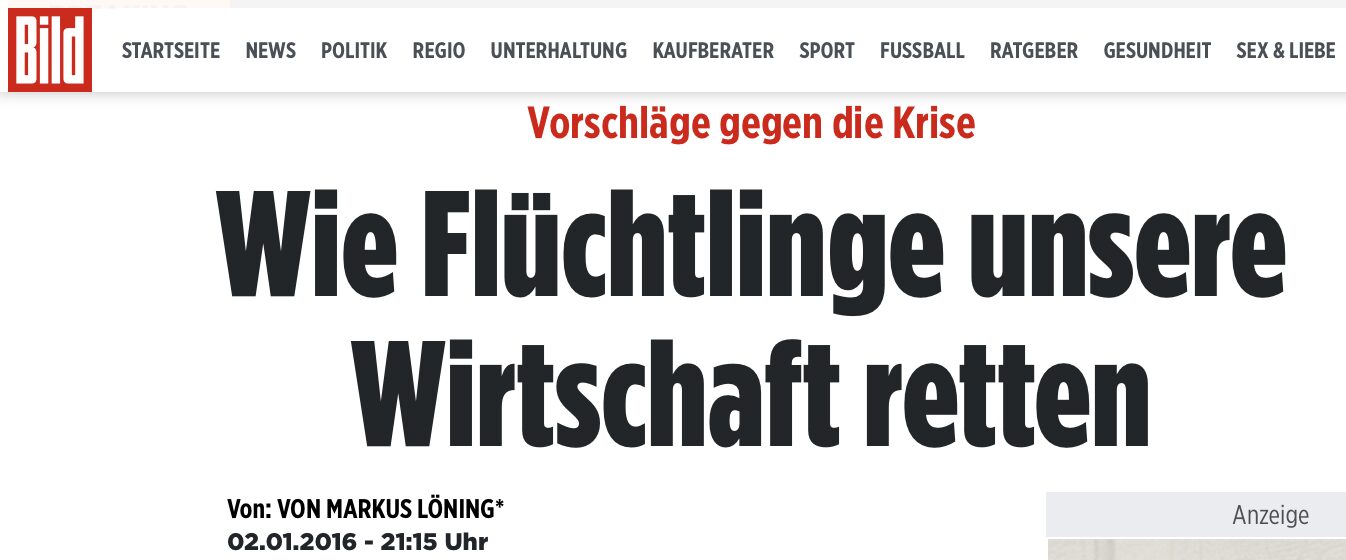
On New Year's Eve 2015/16, however, in Cologne, especially around the railway station, many women had been “danced up to, sexually harassed or robbed” by predominantly North African men (Arendt, Brosius, & Hauck, 2017). On 10 January 2016 BILD asked whether the perpetrators really were refugees and whether the “incidents would benefit the AfD, Pegida and neo-Nazis”. It is therefore certainly mistaken to portray BILD across the board as a medium of hatred and racism (Bulk, 2019). BILD always plays a special role in German journalism, if only because of its enormous reach. The coverage of the largest tabloid regularly oversteps the limits of media ethics in Germany. In doing so, however, BILD marks the boundary and does not necessarily shift it. In his “introspection of the editorial team” of BILD, published in 2023, my colleague Volker Lilienthal was able to find more than just “trace elements of media ethics” (Lilienthal, 2023, pp. 10, 12). The “tabloid programme” may mostly prevail, he says, but the journalists at BILD do discuss and reflect on their own actions. For instance when one of the respondents says: “If we now start calling asylum seekers girl-gropers […], then perhaps something in this country will tip” (Lilienthal, 2023, p. 43).
My colleagues Florian Arendt and Hans-Bernd Brosius, together with Patricia Hauck (2017), analysed the coverage immediately before and directly after New Year's Eve and were indeed able to establish that crime reporting changed and that after New Year's Eve markedly more foreigner-specific attributes such as foreigner, migration background, North African and asylum seeker were mentioned. Maurer et al. (2019) also pointed out in their study that the coverage changed markedly after New Year's Eve.
My colleague Marcus Maurer has repeatedly dealt with the coverage of migration in German media. In a summary of the findings of his research teams, he stresses how polarising the topic is and explains that we humans rate media content as correct when it reflects our own position and perceive it as false when it does not (Maurer, 2026). And so, with the topic of migration, it is simply the case that “one part of the population accuses the media of portraying migrants one-sidedly positively in order to generate support for immigration.” By contrast, “the other part accuses the coverage of serving right-populist stereotypes and of being hostile to migration” (Maurer 2026).
This is the dilemma in which journalism finds itself in the heated debates of recent years, at the latest since the refugee crisis of 2015. In principle one could conclude from this that journalism did a lot right in the migration debate if it is criticised from both sides. If the coverage is too migration-friendly for some and too migration-hostile for others, it was presumably fairly balanced overall. And the empirical studies by Maurer and his colleagues show this as well (Maurer et al., 2019; 2023). Incidentally, BILD celebrated the study as proof of its own balance. Maurer et al. (2019) also pointed out in their study that the coverage changed markedly after New Year's Eve.
In general, Maurer (2026) argues that, on the one hand, the relevance of the topic increased because of the rising number of refugees arriving in Germany, and that coverage therefore grew. In addition, “flight across the sea and later along the so-called Balkan route delivered dramatic stories and images” that met journalistic news factors. We must be clear that journalists also select news according to whether it can be illustrated well (news factors). Images convey emotions more strongly than texts and therefore play an important role in the coverage of refugees. Finally, the study Fünf Jahre Medienberichterstattung über Flucht und Migration (Five Years of Media Coverage of Flight and Migration) can show that people on the run are rather portrayed as in need of protection and in distress. As soon as they have arrived in Germany, however, they are rather portrayed as a security risk and as a threat.
A brief exception was the autumn of 2015, when Angela Merkel said “We can do this” and a culture of welcome spread through the country, which is on the one hand viewed positively to this day but in many quarters negatively. At any rate, Heinrich August Winkler writes of a “moral self-aggrandisement” of Germany, in particular of the Greens, the two large Christian churches and “some large daily and weekly newspapers commonly counted among the left-liberal spectrum” (Winkler, 2019, p. 830) – and thereby explicitly addresses the role of the media.
Winkler also points to the differences between East and West and speaks of a “wave of xenophobic riots and attacks on accommodation for asylum seekers – actions that occurred particularly often in the east of the country, which in the days of the GDR had had much less experience of living together with people from other cultures than the old Federal Republic. Xenophobia also expressed itself violently in the west of Germany not infrequently, but here the picture was determined by professions of a ‘culture of welcome’ under the motto ‘Refugees welcome’, which at times also won the applause of the tabloid press.” (Winkler, 2019, p. 827) And indeed BILD had joined this culture of welcome with a large “We help” campaign.
Perhaps this is even the decisive momentum in the whole story. Merkel had said at the time: “We can do this”, and almost everyone had followed her. The media too. And BILD. Yet at that moment BILD should presumably have been precisely the voice of criticism. With Sebastian Mallek, my then collaborator in a project, likewise funded by the German Research Foundation, “The Chancellors and the Media”, and together with communication studies students at the University of Münster, I looked at the chancellor's crisis communication. In doing so we first took the parliamentary constellation into account.
The third Merkel government, from 2013 to 2017, was carried by the two then large people's parties of Germany: the Union of CDU and CSU and the social-democratic SPD. The opposition in the Bundestag “was made up of the Left Party and the Greens, both primarily ‘migration-friendly’ parties” (Birkner et al., 2020, p. 48). The FDP had paid for its participation in the second Merkel government from 2009 to 2013 by being voted out of the Bundestag. At that moment there was thus no parliamentary opposition with regard to opening the borders and taking in the refugees. Outside parliament, however, the Alternative für Deutschland (AfD), a party founded only in 2013, took shape; it established its communication above all on the platform Facebook, precisely because the classic mass media had largely ignored it. My colleague Michael Haller (2017, p. 93) writes on this: “After it had hardly been noticed by the press (...) until the summer of 2015, the AfD is now […] named more often in the press than any of the governing parties, especially in the wake of New Year's Eve 2015/16.”
The success of the AfD certainly has manifold reasons, and we would considerably exaggerate the role of the media in and for politics if we were to look for the reasons above all in the success of the AfD on social media. In fact, however, right-wing parties in particular, such as the AfD or the FPÖ in Austria, use their own communication channels very successfully and bypass journalism. Via their Facebook pages or their own YouTube channels they reach their followers directly. In a way, these party media of today have their historical models in the party press of the first half of the 20th century, which we will come back to later.
Journalism in Changing Media Environments
Here, in the 2010s, it becomes clear how the media landscape changes, shifts and hybridises. For only very slowly did the platforms move in alongside the established mass media. Television remained the leading medium; its use in 2015, at 208 minutes, was only slightly below the 220 minutes that Germans over the age of 14 spent watching television in 2010 (Engel & Breunig, 2015). According to the results of the ARD/ZDF long-term study Massenkommunikation 2015, the internet, by contrast, was already used for 107 minutes a day on average, a good 20 minutes more than in 2010.
Graphic created with ChatGPT, using data from the ARD/ZDF long-term study Massenkommunikation
Of course this is a marked change, and yet it takes place less disruptively. In retrospect it becomes clear how slowly the change proceeds. The digitally networked infrastructure that seems so omnipresent to us today had long been in place. Societal synchronisation, however, was still handled by television in 2015. TV set the linear beat for the population as a whole, while it was already drawing especially the 14-to-29-year-olds into the digital non-linearity of our present.
The role of the media in particular shows us how significant both newspapers and television and their coverage were in the “refugee crisis”, and that they also contributed to the emotionalisation of the debate (Marcinkowski et al., 2017). If we look at the data on journalism in Germany from 2014/2015, it turns out that, at only 10 percent, journalists want to set the political agenda even less than in the preceding Journalism in Germany studies (2005 and 1993). In addition, less than 1 percent want to support government policy or convey a positive image of the government (Steindl et al., 2017, p. 420; see also further above).
And although the uniformity and closeness to government attributed to them cannot be demonstrated empirically, the migration coverage of 2015, perceived as too positive and above all so uniform, did lead to an estrangement of some parts of the population from the so-called mainstream media. All the more so as there was now an alternative in more than one sense. The Alternative for Germany used alternative media to spread its alternative ideas. Alternative facts, meanwhile, were offered by Donald Trump in the USA.
Donald Trump too can help us better understand the belated turning point from the mass-media age to the digitally networked age. He stands, on the one hand, for the power of television and, on the other, for the changing of the guard, in particular of the press by platforms such as Truth Social and X, formerly Twitter. In 2015 the campaigner Trump embodies almost perfectly the hybrid media system now unfolding, as my colleague Andrew Chadwick has called it. Trump passionately likes watching television and comments on what he has seen on Twitter – a very prominent form of second screen use. Donald Trump is, on the one hand, gladly vilified and, on the other, often portrayed as stupid. But no scholar could probably have put as succinctly as he did his observation from 2012.
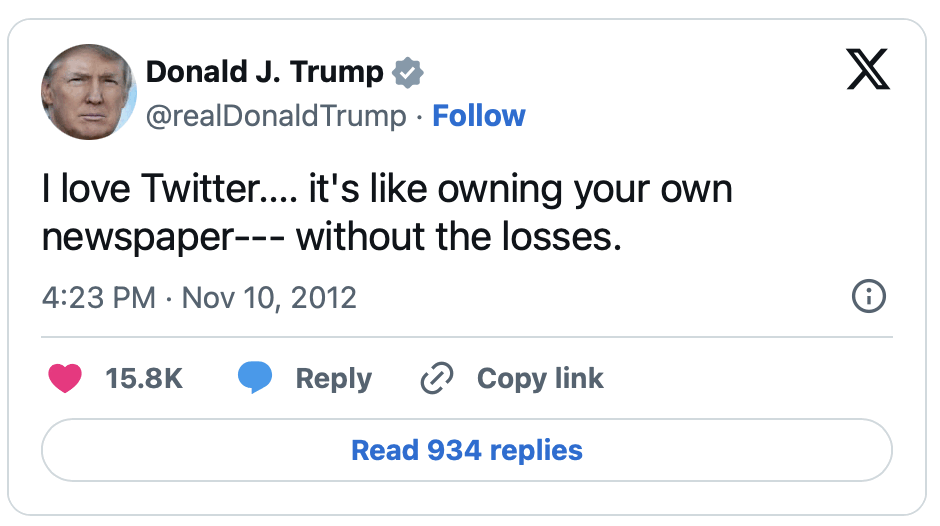
Tweet by Donald Trump from 2012
Being able to tweet, he said, is like owning a newspaper without the financial losses. This names the strength of the platforms just as much as the crisis of the newspaper business already touched upon. In fact, the media setting is in transition, and today's further expanded, multimedia media order is already emerging. My colleagues Nina Steindl and Corinna Lauerer, together with Thomas Hanitzsch, outline the challenges for journalism in Germany in this period as follows (Steindl et al., 2017). Journalism is losing its monopoly as gatekeeper and is increasingly becoming a gatewatcher (Bruns, 2009). That means that it is no longer journalists who organise the access of information to public discourse, but they increasingly watch as other players do it. Because news is also often available free of charge online, journalism increasingly has a funding problem. The economic pressure also shows in the fact that in 2014/15 an estimated 41,250 full-time journalists were working, including approx. 9,600 freelancers (Steindl et al., 2017, p. 411). In 2004/05 it had still been a good 48,000 (Weischenberg et al., 2006b, p. 349).
Figure 5.15: Development of media consumption from 1900 to today (Bernau, Hank and Petersdorf 2014). Image source: Faz.net. https://www.faz.net/aktuell/wirtschaft/unternehmen/zeitungen-in-der-krise-medienwandel-und-internet-13089556/der-medienkonsum-steigt-aber-13089609.html.
The next measuring point in our own automated data collection was the year 2014, in which Germany became football world champion. The digital change is already under way. If we look at the data collected by my Hamburg colleagues at the Leibniz Institute for Media Research, the Hans-Bredow-Institut, the use of the “classic” news media television, radio and print declines overall across all age groups examined between our measuring points 2024 and 2014. Television use for news, however, is still generally high in the 2010s and was only overtaken by internet use in the 2020s (Behre, Hölig, & Möller, 2024).
In our data too, the article following the inverted pyramid principle (Pyramidenprinzip) declines compared with the measuring point of 2004. In these years clicks in particular are also the currency for advertising. The advertising industry is interested in how often a page is visited and how many clicks are generated there. The consequence is clickbaiting, that is, the deliberate provocation of clicks, whether through funny and cute cat pictures or through the deliberate omission of the answer to a decisive W-question, which remains very widespread in online journalism to this day. As here, at BILD and the question about the underpants on 3 September 2026:
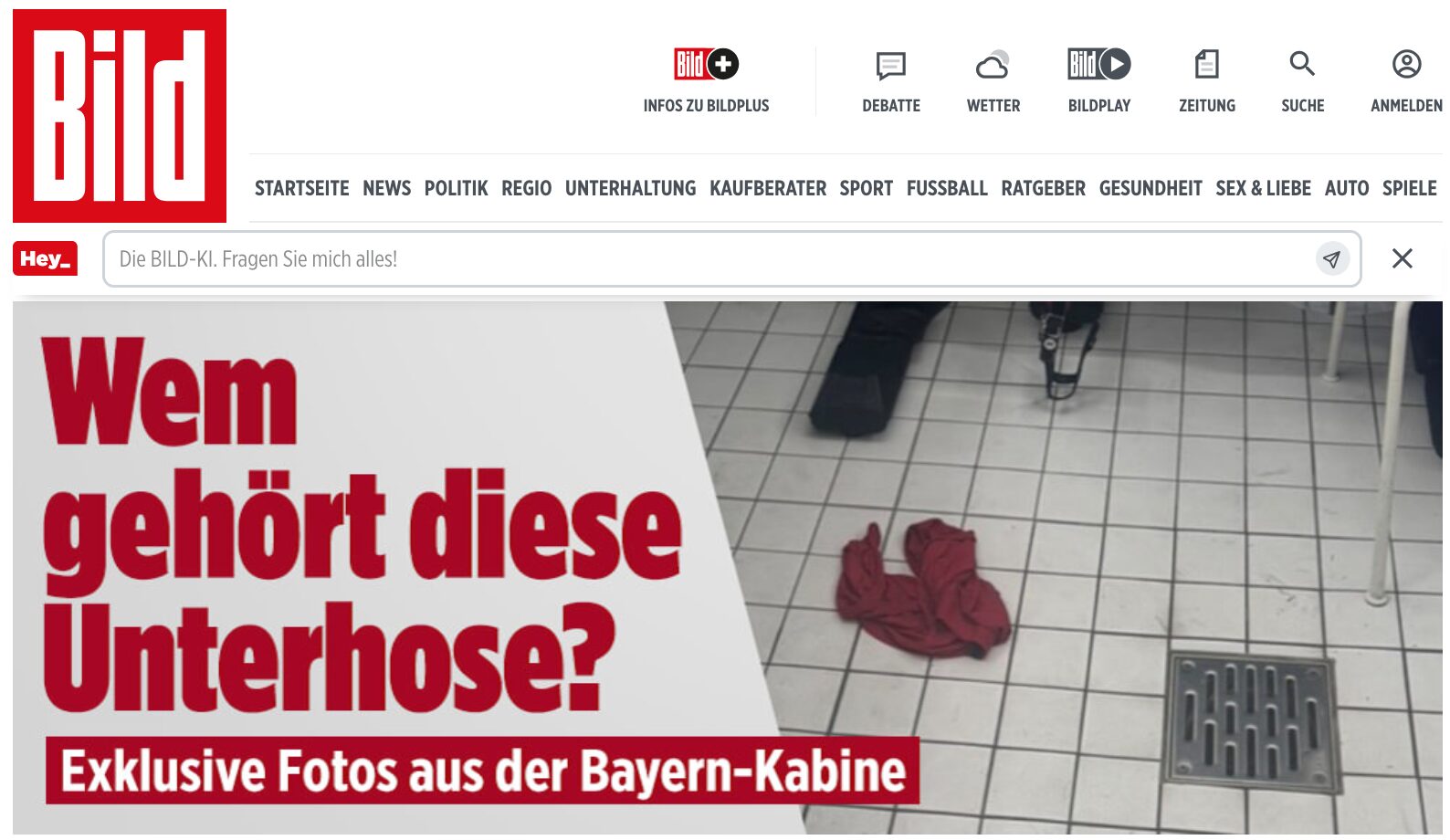
But even if you click on the article, you do not find out whose underpants they are.
But there is another explanation for why journalism no longer feels compelled, in so many texts, to answer the most important W-questions right at the start. The answer is storytelling, not news storytelling (Weischenberg & Birkner, 2008, 2015). After all, the news of the German men’s national team’s 1:0 win at the football World Cup in Brazil is already out there, spreads in no time and is available free of charge.
In our interviews there are voices that generally contemplate a rethink of journalistic writing:
We have to fight for attention, which means that perhaps we should write to be interesting rather than to inform.
In the literature, Marinos (2021), for instance, speaks of reshaping the pyramid (p. 43) and of “featurising” a news item (p. 48). With elements of a feature, “the inverted pyramid” is “topped, as it were, with a little cherry on top” (Marinos, 2021, p. 48). As early as 2001 (pp. 67-77), Weischenberg spoke of “hybrid forms” (p. 67) and outlined that “the Net provokes new forms of narration that do justice to the potential of interactivity” (p. 76). This means that the news pyramid is becoming rarer not only for economic reasons, but also because the possibilities of telling the news have changed – and by no means only online – as have the demands placed on new forms of narration. For given that access to news is still largely free of charge, and despite attempts to start selling news online again, greater value is placed on longer journalistic formats that put things in context, explain and tell stories in an entertaining way. Journalism is very well aware of this through an ever more meticulous analysis of its audience, or rather its audiences (Meier et al., 2024, p. 51):
“Newsrooms measure which pieces generate particularly many clicks or views, how long people stay on the ball, and at what point in a piece they drop out. On the one hand, this has the advantage of placing advertising better and in a more targeted way and of increasing revenue. On the other hand, through the constant feedback of the numbers, journalists see which topics are important, that stories have to be told in an exciting way, and which ways of telling are attractive. Such measurements will increase even further in the coming years, for example in order to reach certain niches better.”
Niches of course also refers to the differentiation of the media offering, already observable in the 2010s, as well as to the worry of a social fragmentation into so-called filter bubbles or echo chambers. Hence people long for the integrating function of the mass media, of television for example.