Journalism on digital platforms · The Century of Journalism
Social media and, overall, the different forms of platform-based communication have above all made the age’s conversation with itself polyphonic and diverse. Journalists, too, feel this way. In one of our interviews it is said that journalism has become more versatile, …
… as far as time, channels and narrative methods are concerned. I do experience that as a kind of freedom."
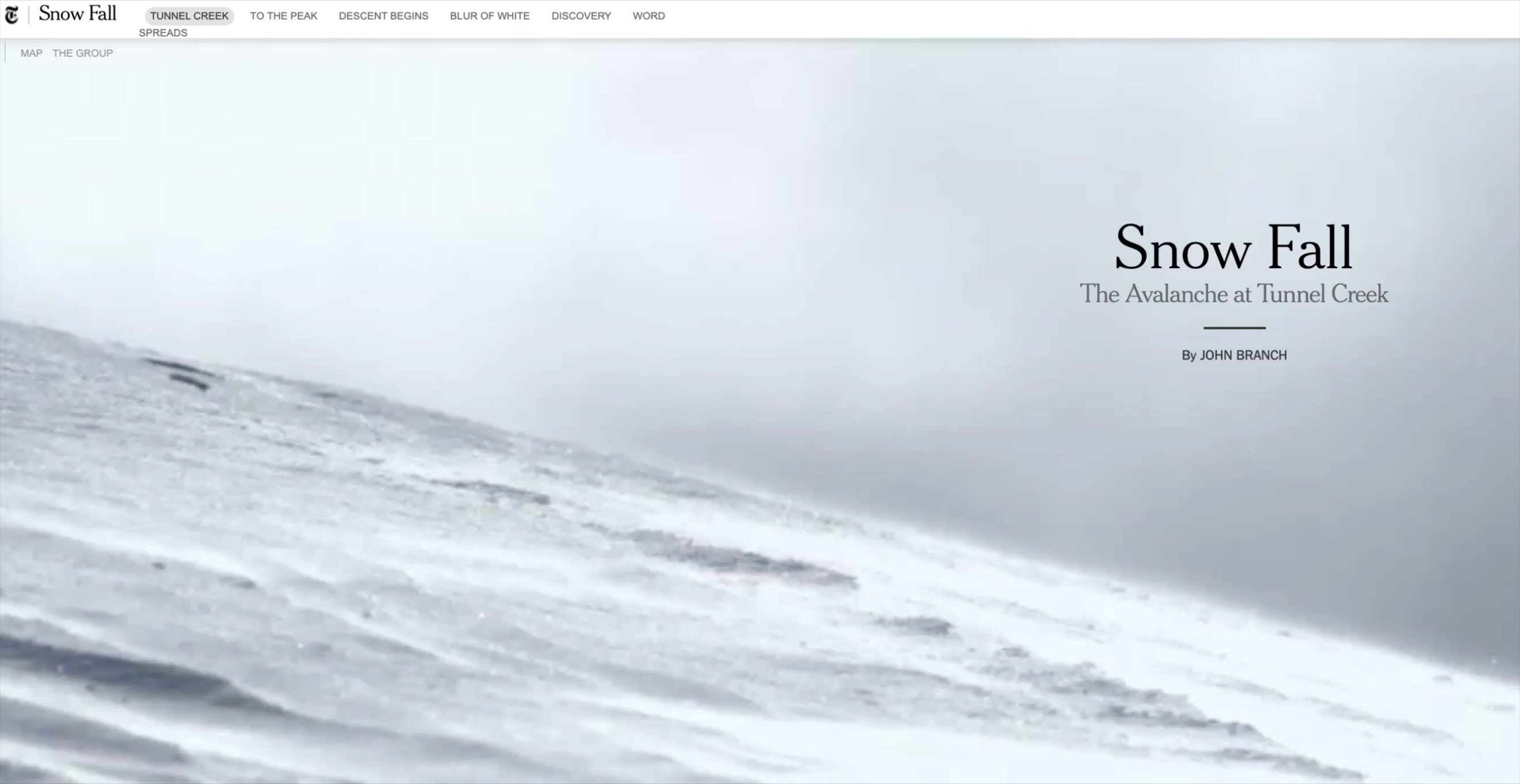
This scrollytelling page, too, is one of the multimedia forms of storytelling for which the story Snow Fall by the New York Times is regarded as an absolute landmark. In a long-form format, different images, texts, sounds and videos can be combined here in order to convey impressions that are as comprehensive as possible.
Podcasting is a very dynamic audio format (and often also a video format on YouTube) in which there is ultimately a great deal of freedom in the dimension of time. For the individual episodes have, at least in principle, no time limit, and users can play the episodes at any time. In podcasting, however, two phenomena also occur that can be seen in social networks as well, and which we therefore want to treat in more depth.
On the one hand, we see here a coexistence of journalistic and non-journalistic actors, for example in sports. Here, journalists from the Sportschau can run a podcast just as the former professional footballers Toni and Felix Kroos do with Einfach mal Luppen. This is competition for journalism, which, however, in some respects definitely serves as a model for those podcasters who do not come from journalism. One could speak of a journalism-ization of further content creators such as influencers.
And podcasting is only one area. Overall, a professionalization of the broadly diversified influencer sphere on social media can also be observed in recent years (Winkler & Birkner, 2026). Influencers are no longer only everyday users who build a community with self-referential content and in doing so advertise products (Freberg et al., 2011). Entire teams and agencies now provide for elaborate posting strategies and pre-produced content (van Driel & Dumitrica, 2021; Watkins, 2021; Wellman et al., 2020). Marketing through Instagram influencers (Veirman et al., 2017) is a wide field, there are guidebooks on how to become an influencer in the social media world (Hartmann, 2021), and this rubs off on everyone else who moves in this sphere.
“The journalist has become much more a marketer of their own work, which is a certain cultural break with the earlier self-image of journalists. To the point that: we carry our own name, our own face much more strongly to market, and we are also active on social media under our own name.
Career politicians, like CEOs, orient themselves on the style of influencers, as do journalists. Loosen et al. (2025) speak of an “influencerization” of journalism, whereby there is a spectrum between journalists who occasionally act like influencers on Instagram and influencers who are also journalists. The pressure of self-marketing already mentioned in the interviews is certainly due to platformization, but cannot be explained without the general pressure to monetize (Garmissen et al., 2025, p. 24; Birkner et al., 2024, p. 1039) in journalism. Here, too, distinctions need to be made.
This is an attempt to earn money either for individual articles or for all content through subscriptions or single sales. In some cases, it is offered to use the journalistic content without advertising, or in combination with advertising. Subscription, single sale and advertising are very established forms of financing for journalism, which have secured journalism’s economic basis for over 100 years. Where direct sale of journalistic content and advertising are dispensed with, so-called crowdfunding or foundation models come into play. These are about involving the audience through donation campaigns, in part also in combination with member and club models. The members are then part of the medium and, where applicable, are also involved in decisions as a community.
These ideas of community financing are likewise developments of models that already existed in the analogue world, as did subscriptions and advertising financing, whether in print magazines or in private television. The possibility of selling individual articles from the journalistic offering exists online, not with a printed newspaper. In this, most journalistic media are (still) trying to sell articles and subscriptions on and for their own news website, which brings two problems with it. News consumers often see journalistic content on social media, and the respective operators have no interest at all in letting their users leave the platform for an external website. If users do manage to find their way to a journalistic news site, they each face a different paywall, a different payment model.
One answer could be a Spotify or Netflix for journalism – a joint platform on which the content of SPIEGEL, BILD, ZEIT and Kölner Stadt-Anzeiger stands side by side and for which a monthly price is paid. “Where is the Spotify for digital journalism?” my colleagues Jonas Weber, Christopher Buschow and Andreas Will (2025) asked, and received as an answer that no publisher could afford such a model (Köhnlein, 2025).
The trend towards a joint approach does seem to exist, at least in larger international investigative alliances such as the European Investigative Collaboration (EIC), which became known through the Football Leaks, and the International Consortium of Investigative Journalists (ICIJ), made famous by the Panama Papers, also in the German context with the investigative alliance of NDR, WDR and Süddeutsche Zeitung. A window to the future is certainly open here, or rather, different futures are open for the financing of journalism.
Stronger than communitization in journalism, we can generally observe the individualization of communication, and here also that journalists in their respective podcasts distance themselves more or less from their long-established media brand. Paul Ronzheimer, for example, keeps his podcast Ronzheimer largely free of too great a closeness to BILD, of which he is deputy editor-in-chief.
The former deputy editor-in-chief of WELT, Robin Alexander, has gone completely independent with his podcast Machtwechsel together with Dagmar Rosenfeld, already mentioned. A new form of independent journalism. The football podcast Rasenfunk, for example, is financed entirely through crowdfunding. While the host Max Jacob Ost relies exclusively on donations here and expressly rejects advertising, the advertising market as a whole has discovered podcasting extensively for itself. This is above all about advertising read out by the podcast host himself, so-called host-read ads. Gabor Steingart, once at SPIEGEL and Handelsblatt and host of his own podcast The Pioneer Morning Briefing, sharply criticized this form of advertising, whereupon Dagmar Rosenfeld replies sharply to him on X:
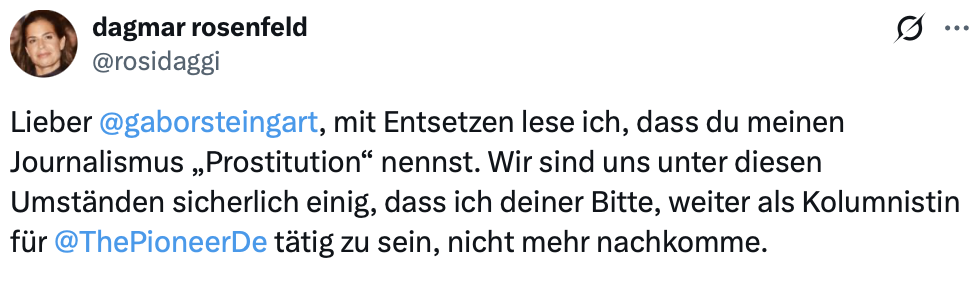
Toni and Felix Kroos also advertise in this way in their podcast. Beyond that, there is a further commonality among the podcasts Machtwechsel, Ronzheimer and Einfach mal Luppen. They do community building at CampfireFM, an app that wants to be a platform for the interactivity of podcasts with their listeners.
Of course, an app that connects a few smaller listener communities cannot accomplish that. Rather, it too stands for an assumed change “From the campfire to the filter bubble”, as my colleague Merja Mahrt (2014) writes, including the feared dwindling integration function of the media and of journalism. This dwindling integrating effect probably also has something to do with the disintegration of journalistic content. That is a somewhat complicated connection, which my colleague Christopher Buschow has divided into three waves of digitalization and their effects on journalism. These waves overlap in many ways and influence the relationship between journalistic media, audience and technology companies (Buschow, 2026).
The relationship with the audience can of course also be assessed differently on social media platforms. For one of the younger journalists we interviewed told us:
“I think we have never been as present and as close to the reader as we are now. Above all through social media.”
With direct address, younger journalists, for example, definitely manage to exchange views with the audience and to respond directly to questions as well as criticism. The closeness to the audience, or to one’s own following, may thus have increased, for better or for worse.
“Well, first of all you have to cope with the fact that people don’t need you at all as a medium, because they have a platform of their own and because through this platform they can reach an incredible number of people, and then you have to reckon with the fact that what you write or broadcast yourself can somehow meet with a pronounced kind of objection through these channels too, all the way to a shitstorm.”
Just as the boundaries between news as video, news as audio and news as text blur, so on social media platforms the boundaries between mass communication and individual communication blur, and alongside the offerings of established journalistic media there are those of politicians, athletes, companies, influencers and private individuals, who likewise communicate with their following or their friends. In any case, journalism is not alone in the communication space on social media:
“In many cities there are citizen-journalism portals, as I would like to call them, or city portals instead of newspaper portals, run not by professionally trained journalists but by people who have an interest in publishing information, and on top of that there is this whole range of institutions, clubs, associations, cities, state governments and so on, who today can all spread information themselves, on all channels. They no longer depend so much on us to bring their information to the readers, and that of course does mean that we have to think and work in a completely new way in the newsrooms, because we cannot be sure that the reader reads this only with us.
The distinction between information conveyed by the Tagesschau and that of an influencer is of course possible, but is not always made, since the respective newsfeed often rushes past far too quickly. And this on ever more channels. Depending on age, TikTok, Instagram and Facebook each play a predominant role, along with YouTube and many others. The problem is that journalism of course goes precisely where its audience is and where attention for its products is generated, but itself does not profit financially from this beyond reach (Altmeppen et al., 2023, p. 80). Only the platform companies profit from it, which Altmeppen et al. (2023, p. 84) see as “decoupled from any orientation towards the common good”.
“Things that used to be considered necessary and absolutely worth reporting are left out where you notice that the hits for these texts are not visible either in the print or in the online business.”
The new possibilities of audience interaction also lead, on the negative side, to “shitstorms” in the digital sphere and even to physical attacks on the street, as Reporters Without Borders (2023) report and as the WJS3 data also show: “That public hostility has by now become part of the job for so many journalists should be even more than before a reason for concern across society.” (Garmissen, 2025, p. 28). These public aggressions against journalists are a consequence of the Corona pandemic and also of the so-called refugee crisis. Both have left deep traces in German journalism.