Journalism and AI · The Century of Journalism
Artificial intelligence is a firm component of journalism, changes everyday journalistic work at all levels (Kilg, 2024) and will thereby also influence communication processes in society. But the areas of application of AI in journalism (Loosen & Solbach, 2020, p. 181), the tasks that artificial intelligence already takes over in journalistic work today, are in part still unclear, as are the trade-offs between opportunities and risks (Meier et al., 2021; Schützeneder et al., 2022; Vogler et al., 2024). In “computational journalism” (Schützeneder et al., 2022, p. 13), for example, fears of job losses in journalism due to AI (Schützeneder et al., 2022, p. 13; Meier et al., 2021) combine with the possibilities that AI is able to take over routine and repetitive tasks in journalism in an automated way (Heesen et al., 2023, p. 16; Schützeneder et al., 2022, p. 15; 2024, p. 2; Steinhau et al., 2024, p. 13; Schwartmann, 2024). If, for instance, AI archives journalistic articles (Schützeneder et al., 2024, p. 4) and maintains databases, journalists have more time for more complex tasks and more room for creativity (Heesen et al., 2023, p. 16). With the help of AI, journalists can also evaluate and interpret the volumes of data available to them more quickly (Dörr, 2023). The term assistant intelligence covers all those tasks that can be carried out by AI and thus free up resources for journalists (Schützeneder et al., 2022, p. 15), which can then flow into improving the news offering (Heesen et al., 2023, pp. 16-17).
The time gained can, however, also have a negative effect. For example, there is talk of a possible overload if working time is filled exclusively with complex and demanding tasks. But first the necessary systems have to be implemented and installed. For media houses this is not a simple process; it is initially resource- and time-intensive and brings uncertainties about who takes over which area of responsibility by when (Heesen et al., 2023, p. 16).
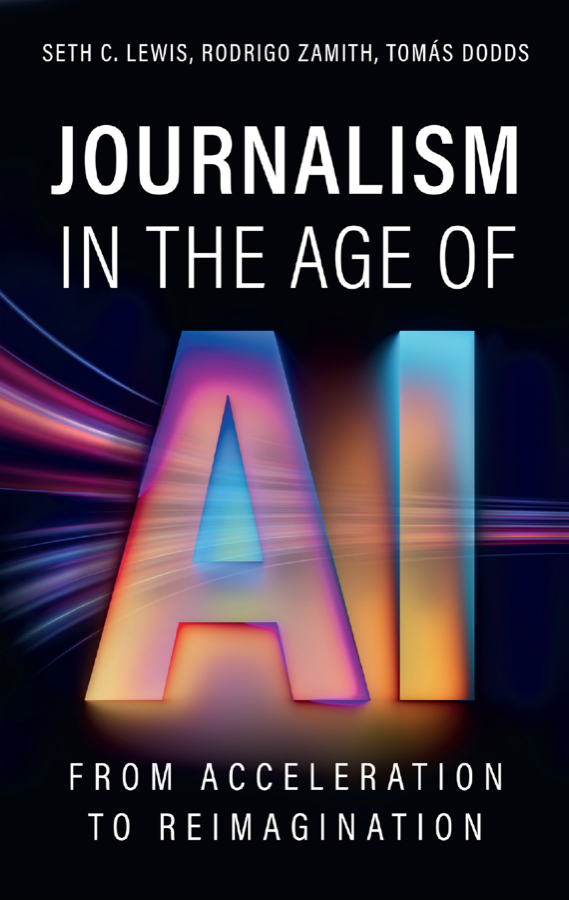
In their new book on journalism in the age of AI, my American colleagues Seth Lewis, Rodrigo Zamith and Tomás Dodds write about the fear that AI would only accelerate journalism’s hamster wheel, but also about the hope that AI would let journalists step out of the hamster wheel (Lewis et al., 2026, pp. 147-148). Yes, it is time to step out of the hamster wheel that has been accelerating ever further for decades, in order to win journalism back and reinvent it (Lewis et al., 2026, p. 157). However, they also tell that one of them was already working on a book about journalism and AI when ChatGPT came onto the market in 2022, and his manuscript at the time already looks rather old-fashioned in 2026 (Lewis et al., 2026, p. 156).
The possible effects of AI in journalism, or on journalism, are also expected or already observed in those fields that classical journalism research has been concerned with for decades: journalistic quality assurance (Arnold, 2023; Prochazka, 2025) and journalistic news selection. Established quality criteria such as transparency, traceability, objectivity and algorithmic fairness (Sarisakaloglu, 2022, p. 8) play a role here, as do balance, non-discrimination, and data and source protection (Überall, 2024).
With regard to journalistic quality, it is problematic, for example, that artificial intelligence is often trained during its development with information that does not necessarily come from reputable or verifiable sources (Haustein-Teßmer, 2024), and that journalistic guidelines and quality criteria therefore cannot be consistently observed. AI can thus reproduce content of lower quality and, in the worst case, help to reinforce existing discrimination (Haustein-Teßmer, 2024). Source protection plays a particular role in investigative journalism. Here it must be ensured that the data generated by AI are not monitored and that neither informants nor journalistic sources are endangered (Heesen et al., 2023, p. 19). In this area too, it is a challenge that artificial intelligence develops at such a high pace that even journalistic users can hardly keep up with the current state of knowledge and thus continually remain behind (Schützeneder et al., 2022, p. 13). At the same time, it is hard for organisations to adapt to these rapid changes, since they are shaped in particular by the principle of inertia (Wolf, 2024, p. 11). A positive aspect of this fast technological development, however, is the continuous emergence of new tools that can help, for example, to understand the audience better or to analyse large amounts of data more efficiently (Schützeneder et al., 2022, p. 13; 2024, p. 3; Wolf, 2024, p. 14).
The editorial process of selecting news has been critically accompanied for decades by research on news factors and news values (Galtung & Ruge, 1965). Here AI-controlled systems could counteract certain distortion effects if they take over the selection of news in the future. Just as possible, however, is that AI amplifies distortions or builds in errors (Schützeneder et al., 2022, p. 15) and, for example, cannot classify and interpret current news because the AI would lack important information that it cannot retrieve due to the topicality of the respective event (Dörr, 2023, p. 214; Haustein-Teßmer, 2024). A very intensive and reflective training of AI would be necessary here (Heesen et al., 2023, p. 17).
Problems, risks and especially misuse (Haustein-Teßmer, 2024) arise above all when journalists are misled by fake news and deepfakes and consequently spread false information. This further spreading can lead to a loss of public trust in the media and their way of working, which is why deepfakes must be exposed as quickly as possible, if applicable also with the support of AI (Heesen et al., 2023, p. 24; Steinhau et al., 2024, p. 12; Schützeneder et al., 2024, p. 3). However, AI itself can also contribute to the spread of false information (Schwartmann, 2024), and from the user’s perspective too it is difficult “to distinguish fakes from non-fakes and to recognise technically evoked manipulations as such” (Steinmaurer, 2025, p. 94).
Media professionals have the option of developing their own AI systems (Überall, 2024), feeding them with information themselves and accompanying the development process fully, thereby taking responsibility for the respective system. The advantage of this approach is that newsrooms can decide on their own which functions the AI should fulfil and which aspects are less relevant. Here the question arises whether the associated effort and financial costs are justified. In most cases the development and implementation of such AI systems requires the involvement of external specialists (Heesen et al., 2023, p. 19). In this case, however, developing one’s own databases can be of great advantage.
The decision can, however, equally be made in favour of an already existing AI system. While costs and resources are generally less of a challenge here, newsrooms enter into dependencies. Media professionals have to weigh whether to invest greater financial means to develop their own systems, or to save resources and potentially compromise their own journalistic values, if these do not match those of large technology companies (Heesen et al., 2023, p. 19). Smaller newsrooms often do not have the financial resources to implement AI tools, let alone to build their own AI. In this way inequalities arise or deepen, and the plurality of the media landscape is endangered, which automatically also affects the diversity of prevailing opinions and discourses, which would thus disappear (Heesen et al., 2023, p. 19; Schützeneder et al., 2022, p. 15).
Even if the increasing use of AI in many areas does not necessarily have to lead to job losses, working reality will change in many places, which will also pose challenges for media houses and newsrooms (Heesen et al., 2023, p. 21). This development can, however, also be seen as an opportunity if journalists are involved in the process from the start. In this way not only can their fear of change be reduced, but they can also cope better with the adjustments (Heesen et al., 2023, p. 21).
For AI must be intensively monitored and regulated by humans in order to meet the journalistic duty of care (Schwartmann, 2024; Kilg 2024). For newsrooms and journalists this means that at the beginning they have to put in more effort than the use of AI originally promises (Heesen et al., 2023, p. 22). Moreover, it is necessary that at all times a contact person for questions about AI is present (Überall, 2024).
The skills required for dealing with artificial intelligence are not equally present among all media professionals. While for some these skills were already taught during their training, others only have to learn them with the increasing spread of AI technologies (Heesen et al., 2023, p. 23). Where artificial intelligence is already part of training, questions should be discussed such as in what way the journalists of the future should think and work and what role AI could play in this (Dörr, 2023). Opportunities open up for the professional development of journalists beyond their previous roles. In future it could, however, become necessary to also have skills outside the previous occupational profile (Heesen et al., 2023, p. 23). The SPIEGEL (here’s the way to the SPIEGEL as an institution of the century) has published its principles for dealing with AI.
Increasingly, people speak of AI-supported news offerings in which AI creates personalised news for users. This involves risks, however, since so-called filter bubbles or echo chambers can form and the world is perceived in a distorted way (Heesen et al., 2023, p. 24; Schützeneder et al., 2024, p. 5). On the other hand, this development can also be seen as an opportunity if AI is able to generate individually tailored news mixes for users, especially for younger target groups. Beyond that, artificial intelligence can also be useful when it develops tailor-made pricing models based on the individual likelihood and possibilities of taking out a subscription (Schützeneder et al., 2024, p. 5).
A further challenge concerns the effects on copyright. AI language models such as GPT-3 could in future automatically extract journalistic content, rephrase it and publish it as their own articles. If this technology is misused, it can lead to news from competing publishers being used and processed without the corresponding rights being observed. This could endanger not only quality journalism but also shake public trust in the media and their ethical standards (Heesen et al., 2023, p. 25).
Used positively, AI can play a significant role in analysing media content. It makes it possible to collect detailed information about the reach of articles and to evaluate how long users interacted with a particular post. This analysis can give valuable insights into which content is particularly engaging or relevant for the audience. Through the precise capture of usage data, newsrooms and media professionals can adjust their strategies for content distribution and optimisation in a targeted way and thus improve the effectiveness of their communication (Schützeneder et al., 2024, p. 5).
Despite obvious risks and opportunities of artificial intelligence in the journalistic field (Wolf, 2024, p. 19), it is essential to regularly question and discuss what role AI plays in journalism, or should play, and in which areas it is deliberately integrated or excluded (Loosen & Solbach, 2020, p. 197; Dörr, 2023, p. 213). In this context, the description of artificial intelligence as a tool and not as a “magical element” (Kilg, 2024) is particularly central. For human empathy and creativity cannot be replaced so easily. And since we are speaking so much about humans as well as machines right now, we want to return to a further W-question: Who makes journalism?